
Looking west along the Ashton Canal
“from a heavily industrial landscape…into an internationally recognised destination for sport, entertainment and leisure”
Flashback Friday isn’t always easy when a few decades of enthusiastic plant growth have other ideas! 🪴
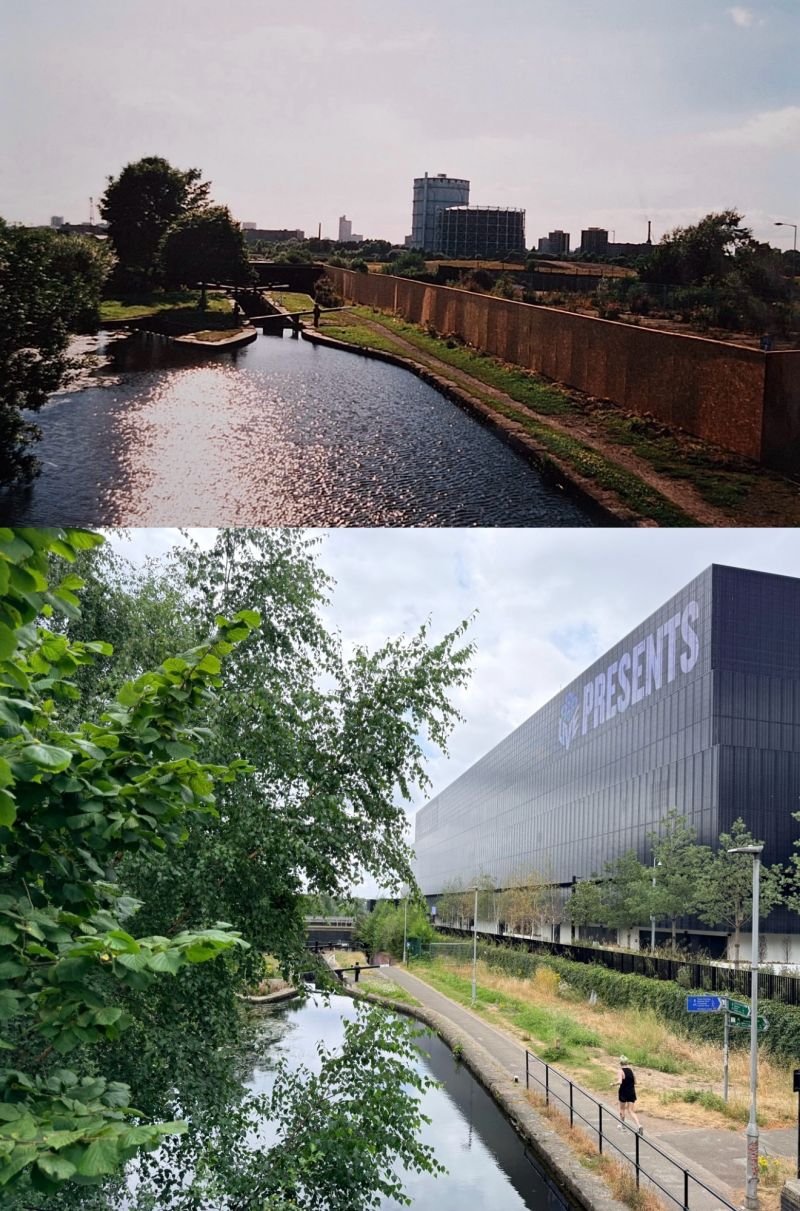
The top photo was kindly provided by Steve Welsh and was taken in 1999 from Alan Turing Way, looking west along the Ashton Canal.
Visible in the background are two of the Bradford Road gas holders - symbols of Manchester’s industrial past (the last remaining gas holder was demolished in 2024).
At the time of Steve’s photo this part of Eastlands was still in the early stages of a remarkable transformation. Once one of Manchester’s great industrial districts, East Manchester experienced dramatic decline during the late 20th century.
Between 1970 and 1985, the area lost around 60% of its economic base and more than 33,000 jobs, while the population fell from 164,000 in 1951 to just 62,000 by 2001.
Regeneration gathered pace from the late 1990s with the establishment of New East Manchester as an Urban Development Company: a partnership between Manchester City Council, the North West Development Agency (NWDA) and English Partnerships (later Homes England). Its role was to coordinate investment, housing renewal, infrastructure projects and economic development across East Manchester.
This was accelerated by the 2002 Commonwealth Games (awarded to Manchester in 1995) and the development of Sportcity. Shortly after the Games, Manchester City Football Club moved from Maine Road to what was at the time known as the City of Manchester stadium.
With this context in mind, the bottom photo - taken last week from almost exactly the same spot - looks towards Co-op Live.
Designed by Populous the arena has become one of the most prominent landmarks on the Etihad Campus. It opened on 14 May 2024, when Elbow became the first act to perform a full public concert at the new venue. In February this year it hosted the BRIT Awards Limited, which will return next year.
The scheme is another major milestone in East Manchester’s regeneration story, over the past three decades: a journey that has seen the area evolve from a heavily industrial landscape, through the Commonwealth Games era and the creation of Sportcity, into an internationally recognised destination for sport, entertainment and leisure.