
For the first time in decades, all 10 Greater Manchester local authorities will soon have an up-to-date local plan in place, all aligning with the sub-regional Places for Everyone (PfE) plan.
So what?
Local plans are the cornerstone of the English planning system, against which all development proposals, at least in theory, are to be assessed. They’re meant to help inform the development industry and shape places to ultimately deliver “sustainable development” in all its guises.
And yet, many of Greater Manchester’s local authorities (and Greater Manchester is not the outlier in this fact) haven’t had an up-to-date plan in place for over 10 years.
This significant moment – the prospect of a coherent and up-to-date planning framework across all 10 boroughs – is on the horizon and tantalisingly close.
The “what” and “when” of the local plan rollout
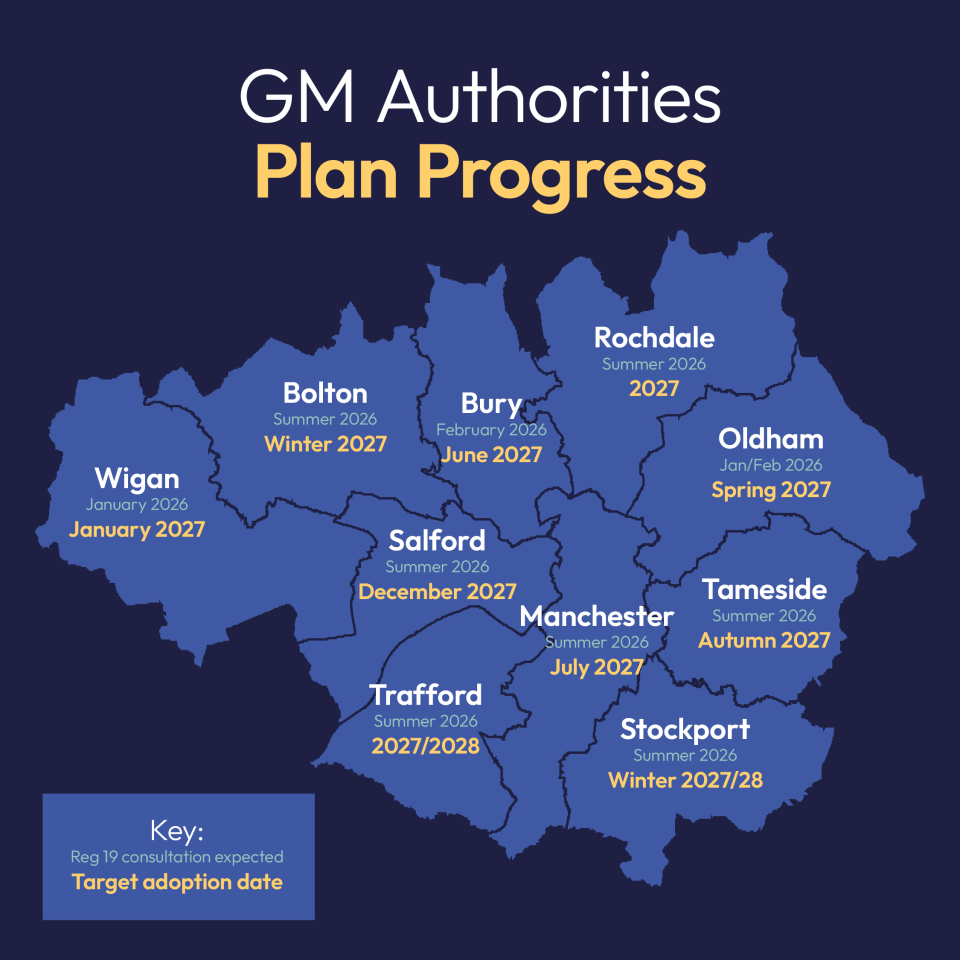
The table below shows the latest progress from across the sub-region, as at November 2025. Significantly, it shows that all 10 boroughs will be consulting on their publication draft plan within six months of each other.
| Borough (& date plan adopted) | Latest consultation | Consultation on Publication Plan (Regulation 19) expected | Current target date for adoption |
|---|---|---|---|
| Bolton Core Strategy (2011) (Allocations Plan adopted 2014) |
Autumn 2025 | Summer 2026 | Winter 2027 |
| Bury Unitary Development Plan (1997) | Spring 2025 | February 2026 | June 2027 |
| Manchester Core Strategy (2012) | Autumn 2025 | Summer 2026 | July 2027 |
| Oldham Joint Core Strategy & DM Policies DPD (2011) | Jan/Feb 2024 | Jan/Feb 2026 | Spring 2027 |
| Rochdale Core Strategy (2016) | Dec 2024 to Jan 2026 | Summer 2026 | 2027 |
| Salford Local Plan Part One (2023) | Winter 2024/25 (Part Two Local Plan) | Summer 2026 | December 2027 |
| Stockport Core Strategy (2011) | Consultation on draft plan underway | Summer 2026 | Winter 2027/28 |
| Tameside Unitary Development Plan (2004) | Due Winter 2025 | Summer 2026 | Autumn 2027 |
| Trafford Core Strategy (2012) | Autumn 2025 | Summer 2026 | 2027/2028 |
| Wigan Core Strategy (2013) | Summer 2025 | January 2026 | January 2027 |
Why it’s a big moment for the development industry
This is a moment Greater Manchester has been working towards for a long time. What will it mean for the industry?
Alignment with the 'Places for Everyone' plan is a significant step forward
PfE policies provide strategic direction, spatially, for core growth areas. But many of the adopted development plans in Greater Manchester don’t match up with this strategic policy position. Atom Valley in Bury is an excellent example; it’s a growth ambition that is set out under Policy STRAT6 of PfE and within the Northern Gateway Development Framework SPD but is not currently reflected in Bury’s own development plan (currently the UDP from 1997!)
Ironing out discrepancies and potentially confusing contradictions will bring clarity to the market and help development proposals to better align with local authorities’ ambitions. A win win.
We should see more plan-led, rather than speculative, housing delivery
The development plan is the starting point for considering any development proposal and yet, without an up-to-date local plan (or where a local authority can’t demonstrate a five-year housing land supply), the “tilted balance” in NPPF paragraph 11d is engaged, rendering housing policies out of date.
That means that having a planned and coordinated approach to development is harder (arguably impossible) to achieve, opening the doors to speculative housing development across the sub-region.
GM-wide local plan adoptions in 2027 will significantly change the narrative, with plan-led, strategically planned development taking centre stage. Again, this will bring greater certainty to the market, which can only be a good thing.
Projects across the sub-region will be subject to the same standards
We see a lot of discrepancies on things like space standards across the board. Some local plans refer to up to date standards while other, older, plans don’t. Similarly, whilst now set out within PfE specific requirements for developments to reduce carbon emissions and energy usage are also not currently reflected in individual Local Plans.
When all 10 GM authorities have up to plans, drafted to align with the sub-regional plan, these discrepancies will be eradicated, paving the way for simpler pre-application negotiations and clearer expectations for design.
Local Plans will have more impact
The power of the PfE plan was that it could write boundary-spanning policies to address sub-region-wide issues. The Atom Valley employment focus, which spans Bury, Rochdale and Oldham, is a case in point. With that now in place, the policies of the three relevant local plans now being drawn up will be able to support this important sub-regional goal and have more impact than they would have had in isolation.
What to watch out for next
By the end of 2027, we can expect to have a geographically complete and coherent picture of what development will be delivered over the next 20-30 years. Once all plans are aligned, we’re hopeful that future plan preparation will continue to move forward at the same pace. And that should allow for a more joined-up approach to delivery of key strategic objectives, both at the local level and across the sub-region.
Yes, timeframes do slip. Anyone working in the industry knows that all too well. But we’re undoubtedly edging closer to a significant moment in our sub-region’s story, and we’re looking forward to seeing the positive impacts it will have on the delivery of meaningful developments across Greater Manchester.
